- admin
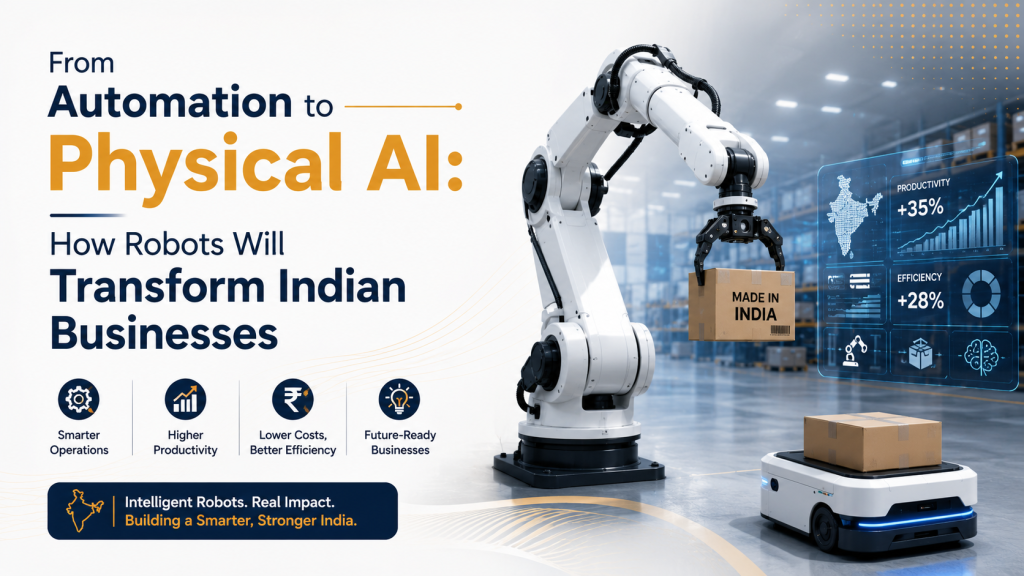
From Automation to Physical AI: How Robots Will Transform Indian Businesses
Physical AI is taking robotics beyond fixed automation. Instead of simply repeating pre-programmed movements, newer robotic systems combine sensors, computer vision, AI models, software, and mechanical control to perceive their surroundings and respond to changing conditions.
What Is Physical AI?
Traditional automation generally follows predefined instructions. If the environment changes significantly, the system may need to be reprogrammed.
A Physical AI system can combine:
- Cameras and sensors.
- Computer vision.
- AI and machine-learning models.
- Robotics software.
- Motion planning.
Why Physical AI Matters for Indian Businesses
India’s automation opportunity is not limited to large automotive factories.
Businesses are increasingly looking for ways to:
- Improve productivity.
- Reduce workplace injuries.
- Address skilled-labor shortages.
- Increase production capacity.
- Reduce repetitive manual work.
- Improve quality control.
Where Physical AI Is Being Deployed
Manufacturing remains one of the strongest use cases for robotics in India.
Robots can handle:
- Assembly.
- Welding.
- Material handling.
- Inspection.
- Packaging.
Warehouse and Logistics Automation
E-commerce, quick commerce, and modern retail are increasing pressure on warehouses to process more orders in less space.
Robotics can support:
- Sorting.
- Picking.
- Packing.
- Inventory movement.
- Pallet handling.
Precision Agriculture
Indian farms are often smaller and more fragmented than large industrial farms in developed markets. This makes conventional large-scale agricultural automation difficult.
Physical AI can nevertheless support:
- Crop monitoring.
- Precision spraying.
- Weed detection.
- Soil monitoring.
- Autonomous or assisted machinery.
- Drone-based inspection
Instead of trying to replace agricultural workers completely, these systems can target repetitive or precision-intensive tasks.