- admin
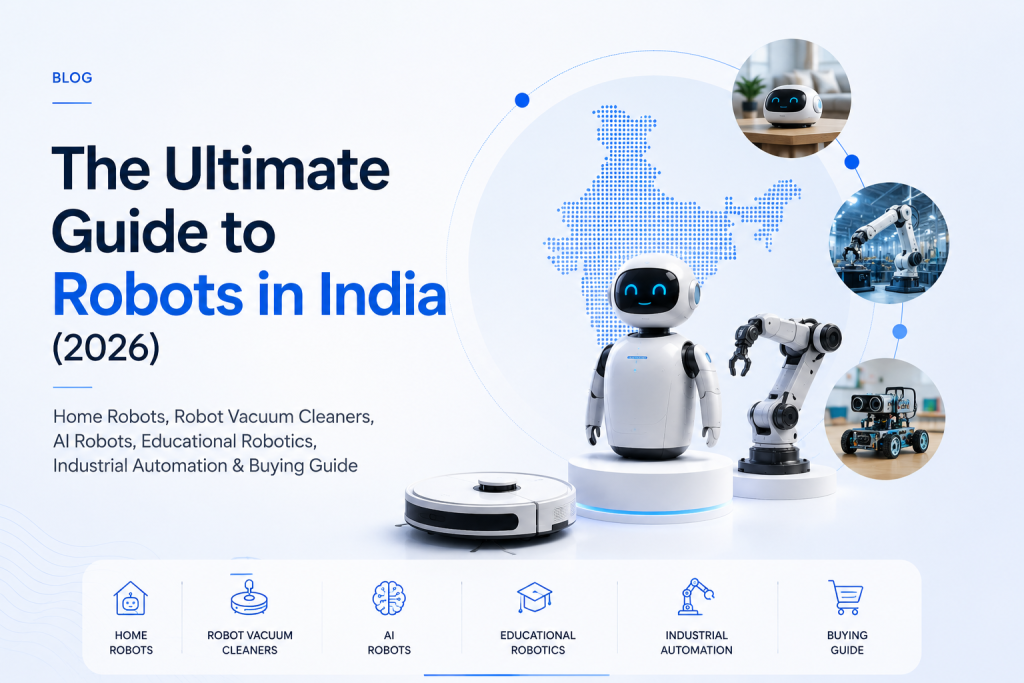
The Ultimate Guide to Robots in India (2026): Home Robots, Robot Vacuum Cleaners, AI Robots, Educational Robotics, Industrial Automation & Buying Guide
Robots in India in 2026 span five practical categories: home robots (vacuum cleaners, mops, security units), AI robots (computer-vision and machine-learning driven devices), educational robotics kits (Arduino and Raspberry Pi based), industrial robots (cobots, AMRs, AGVs for manufacturing and warehousing), and service robots (hospitality, retail, healthcare).
Introduction: What Is a Robot, and Why Now?
A robot is a programmable machine capable of carrying out a sequence of actions automatically, sensing its environment, processing that information, and acting on it through motors or other moving parts. That single definition now covers an extraordinarily wide range of devices sold and used in India: a ₹10,000 robot vacuum cleaner gliding under a sofa in Pune, a ₹1,500 Arduino kit being assembled by a ninth-grader in Coimbatore, and a six-axis welding arm running a night shift in a Chennai auto plant.
What Is a Robot?
Quick Definition: A robot is a programmable machine that senses its environment through sensors, processes that data via a controller, and acts on it using actuators, with artificial intelligence increasingly layered on top to allow the robot to adapt rather than simply follow fixed rules.
The five components every robot shares
Regardless of category, a ₹1,500 educational kit or a ₹1.5 crore industrial arm, virtually every robot is built from the same five functional building blocks.
Sensors are the robot’s senses. Ultrasonic sensors measure distance using sound waves, infrared sensors detect heat or proximity, cameras capture visual data, and LiDAR units measure distance using laser light to build spatial maps. A robot vacuum cleaner typically combines several sensor types simultaneously, a cliff sensor to detect stairs, a bump sensor for collision detection, and either LiDAR or a camera for room mapping.
How these components work together
Key Takeaway, Chapter 1: Every robot, regardless of price or category, is built from sensors, a controller, and actuators. AI and machine learning are an additional intelligence layer that makes a robot adaptive rather than purely rule-based; this layer is what separates a basic automation robot from a genuinely smart one.
Types of Robots
Robots sold and deployed in India fall into nine broad categories, each with distinct use cases, buyers, and price points.
Home Robots
Devices designed for domestic use, robot vacuum cleaners, robot mops, window cleaning robots, lawn mowing robots, pool cleaning robots, pet care robots, and home security robots. This is the largest consumer-facing category by unit volume in India.
Industrial Robots
Reprogrammable machines used in manufacturing, typically robotic arms with three or more axes of movement, performing welding, assembly, painting, and material handling on production lines, predominantly in automotive, electronics, and pharmaceutical manufacturing.
Medical Robots
Robotic systems assisting in surgery (surgical robots offering enhanced precision), hospital logistics (medicine and sample transport within facilities), and rehabilitation (robotic exoskeletons and physiotherapy assistance devices). Adoption in India is concentrated in metro-area private hospitals and select government medical research institutions.