- admin
Food Serving Robot for Indian Restaurants: The Complete Guide
The National Restaurant Association of India’s India Food Services Report 2024 found that close to 60 percent of Indian restaurant operators report shortages in both kitchen and service staff, a figure that has not improved since the post-pandemic recovery flattened hiring pipelines across Tier 1, 2, and 3 cities alike. A food serving robot does not eliminate that problem, but for a restaurant running 60 to 120 covers per shift with three or four delivery runs per table, it addresses the part of that problem that is most visible to guests: the gap between food leaving the kitchen pass and food reaching the table.
What a Food Serving Robot Does and What It Does Not Do
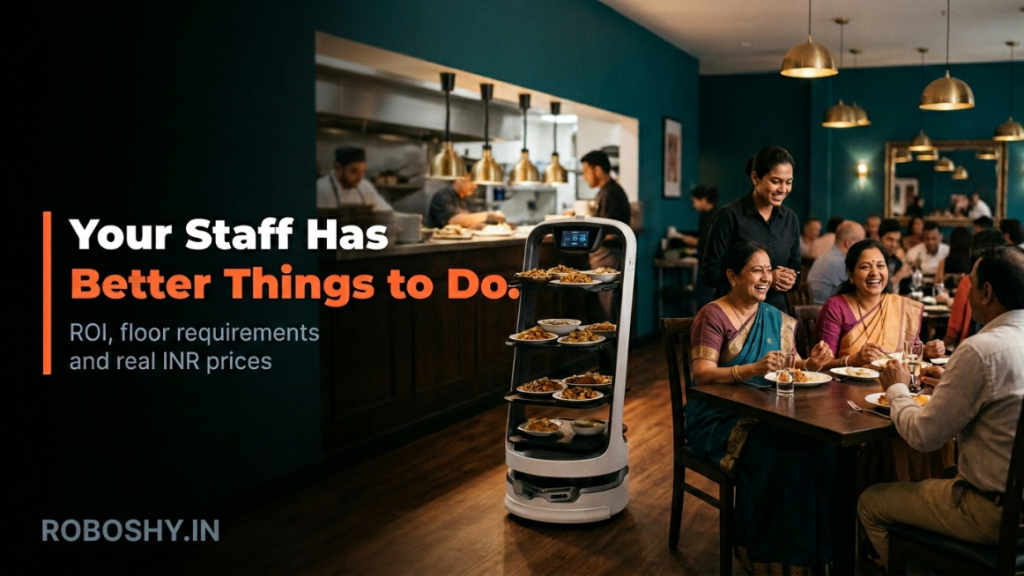
A food serving robot is an autonomous mobile robot designed to transport dishes from a kitchen pass or serving station to a specified table number, using onboard sensors, SLAM navigation, and pre-mapped floor plans to find its path without human guidance on each delivery. The category covers robots with between two and four tray levels capable of carrying eight to forty kilograms of food and beverage in a single run, operating for ten to twenty-four hours on a single charge or a swappable battery, and navigating through occupied dining rooms at speeds between 0.5 and 1.2 metres per second.
The robot’s functional contribution in a restaurant is specific and limited. It moves food from a fixed dispatch point to a fixed table destination. A staff member loads the tray, presses the table number, and the robot departs. At the table, either the robot announces arrival and guests retrieve their dishes, or a server meets the robot and transfers the plates.
Which Indian Restaurant Formats Produce a Return and Which Do Not
Restaurant format determines whether a food serving robot generates a measurable return or becomes an underutilised asset within six months. Four variables drive the format suitability assessment: table count, aisle width, service model, and peak-hour delivery frequency. Each of the five major restaurant formats in India scores differently across these variables.
Casual Dining: Strongest ROI Category
Casual dining restaurants operating between 40 and 120 covers, with fixed table layouts and a service model where one server manages four to eight tables simultaneously, represent the format where a food serving robot delivers the clearest return. Delivery runs to the table are high-frequency, the path between kitchen and dining room is consistent, and the server’s time is the primary constraint during peak service. A single robot handling twelve to eighteen delivery runs per hour across a 90-cover floor allows two servers to manage what would otherwise require three, which changes the staffing cost calculation without eliminating the human relationship at the table.
Banquet Halls and Wedding Function Venues: High Volume Return
Banquet operations serving buffet-style functions or seated multi-course events use food serving robots differently from casual dining. In large-format events with 200 to 500 guests, robots carry food from staging stations to service points across the floor, reducing the number of service staff required for the physical transport of food while human staff focus on portion service and guest interaction at the station. The consistent floor layout, the absence of walk-in traffic during service, and the high per-event food volume make banquet deployments among the most financially efficient in India’s hospitality context.
QSR and Counter Service: Not Suited
Quick service restaurants and counter service formats do not have a delivery path that a food serving robot fills. Guests collect their own orders at a counter, which means there is no table-to-kitchen delivery sequence to automate. Deploying a robot in a QSR environment addresses a process that does not exist in that format and generates no operational return.