- admin
Robotics-as-a-Service in India: Costs, Use Cases, and When Businesses Should Rent Robots
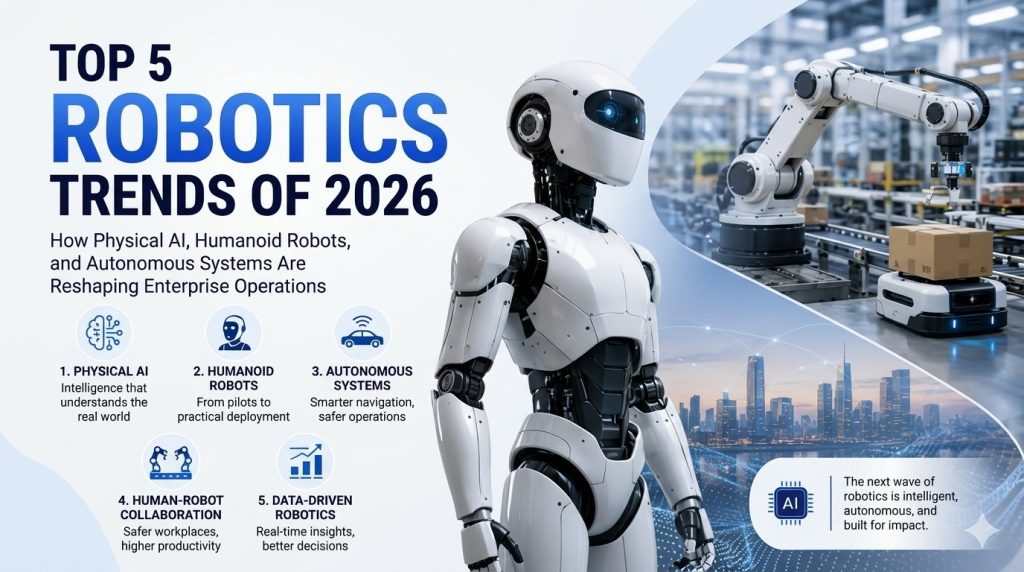
Robotics in 2026 is no longer about isolated automation. It is about intelligent, adaptive systems that perceive, reason, and act in the physical world. The convergence of artificial intelligence, advanced sensors, and edge computing has created a new category: Physical AI, machines that can understand and interact with real-world environments autonomously.
1. Physical AI: Powering the Next Generation of Robotics
Physical AI refers to artificial intelligence systems embedded into physical machines, robots, vehicles, drones, and industrial equipment, that can perceive, reason, and act in real-world environments autonomously
Why it matters for enterprises:
Enables machines to adapt to dynamic environments
Reduces dependency on preprogrammed instructions
Supports real-time decision-making in complex scenarios
Bridges the gap between digital intelligence and physical action
2. Humanoid Robots Move Toward Commercial Manufacturing
Humanoid robots, machines designed with human-like structure and movement capabilities, are transitioning from research labs to commercial deployment. In 2026, leading manufacturers including Tesla, BMW, Mercedes-Benz, and Figure AI are testing and deploying humanoid robots across automotive, electronics, and logistics operations.
Key manufacturing applications:
Material handling and transportation
Assembly line assistance
Human-robot collaboration in existing factory layouts
3. Autonomous Mobile Robots (AMRs) Expand Warehouse Automation
Warehousing and logistics remain the earliest and largest adopters of Physical AI robotic systems. Amazon recently deployed its millionth robot, coordinated by its DeepFleet AI model to improve fleet travel efficiency by 10%.
Enterprise benefits:
Autonomous inventory management
Intelligent order fulfillment
Real-time route optimization
Human-robot collaboration in fulfillment centers
4. Edge AI Enables Real-Time Autonomous Decision-Making
Physical AI systems require low-latency processing because machines must respond instantly to changing environments. Edge AI, processing data directly on devices rather than relying on cloud computing, has become essential for real-time autonomous operations.
Key advantages:
Faster decision-making without cloud dependency
Improved data privacy and security
Enhanced system reliability in remote locations
Energy-efficient processing for mobile robots
5. Vision-Language-Action (VLA) Models Transform Robot Intelligence
Physical AI is adopting training methods from large language models while incorporating data that describes the physical world. Multimodal vision-language-action (VLA) models integrate computer vision, natural language processing, and motor control to help robots interpret surroundings and select appropriate actions.
What VLA models enable:
Natural language instructions for robot tasks
Better understanding of 3D environments
Improved object recognition and manipulation
Context-aware decision-making